 Skip to content
Preclinical Formulation Development
Let Ichor’s preclinical formulation development team help you identify the conditions most likely to improve drug substance instability and support downstream development using a structured design of experiments (DoE) approach.

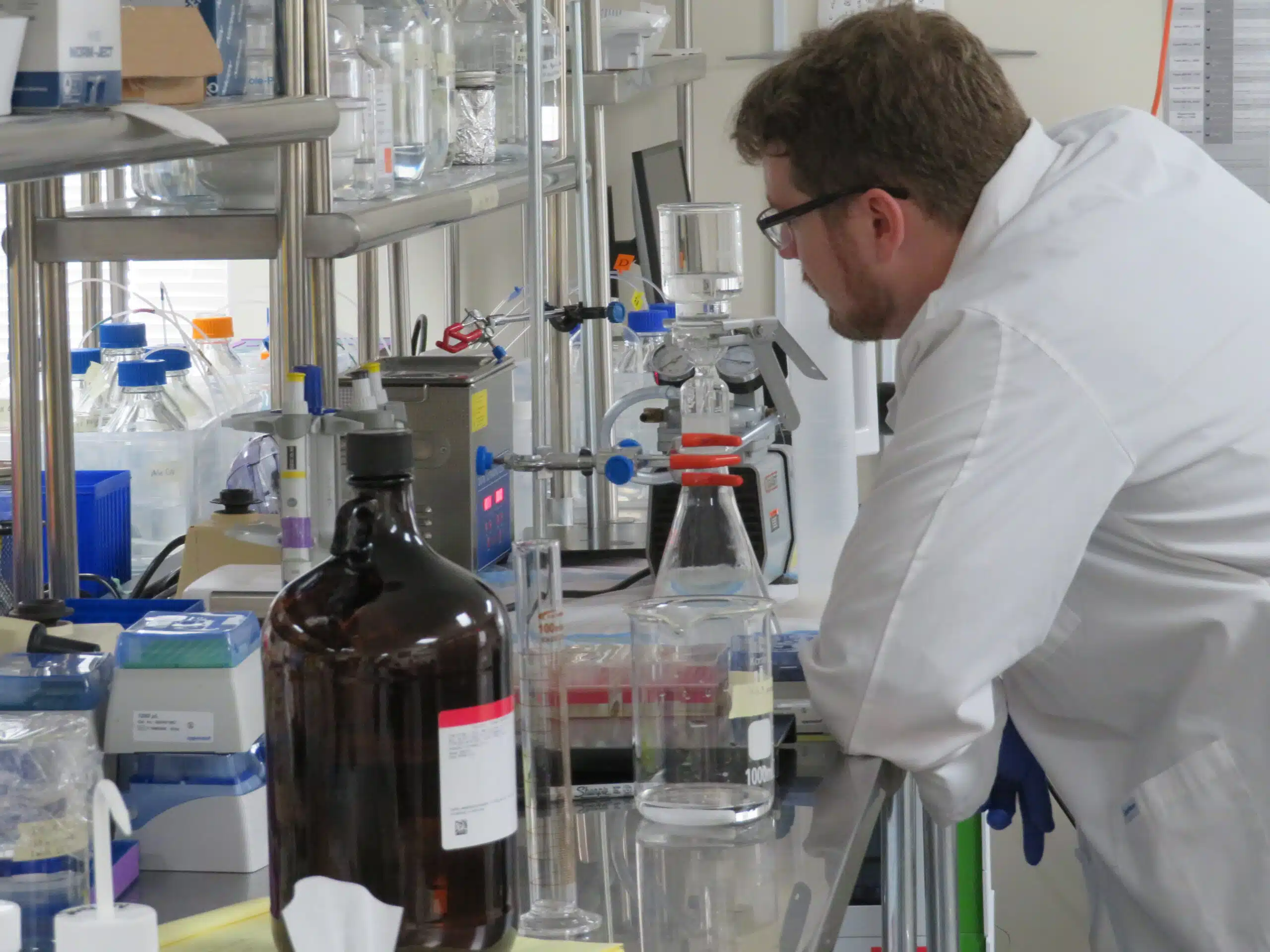
Ichor’s preclinical formulation development services evaluate key causes of drug substance instability, providing a clear and practical readout to help determine which formulation variables are driving solubility, association, aggregation, or stress-related problems and which strategy is most likely to correct these issues.
Why Use DoE?
| Benefit | Value |
|---|---|
| Efficient Screening | Evaluate multiple variables and interactions simultaneously instead of changing one factor at a time. |
| Faster Decisions | Prioritize the formulation conditions most likely to improve stability before committing material to deeper optimization. |
| Mechanistic Insight | Use diagnostic assays to distinguish charge, hydrophobicity, metals, unfolding, and nonspecific protein interactions. |
| Clear Ranking | Receive model-based outputs that rank the strongest formulation effects and guide the next experimental step. |
| Optimization Ready | Translate screening results into targeted excipient testing and final formulation optimization. |
Featured Capabilities
Broad pH Assessment
Our preclinical formulation development is used to identify conditions that improve solubility and reduce pH-dependent association.
Ionic Strength Screening
Evaluate sodium chloride for charge-driven protein association or aggregation.
Conformational Stabilization
Assess trehalose for marginal stability and stress-induced unfolding.
Hydrophobic Aggregation Testing
Use various detergents to probe hydrophobic patch-driven aggregation.
Metal-Driven Instability
Evaluate EDTA to identify metal-catalyzed aggregation pathways.
Protein Interaction Control
Assess arginine for nonspecific protein-protein interactions.
Featured Model: DoE Preclinical Formulation Development

The initial DoE formulation screen evaluates approximately 36 conditions across six diagnostic factors. Rather than producing a simple pass/fail result, the model shows how each factor influences the measured response and identifies important interactions. Trend plots, effect rankings, and response-surface visualizations provide a practical basis for selecting promising conditions and designing focused follow-up studies.
Capabilities and Services Summary
Formulation Trend Plots
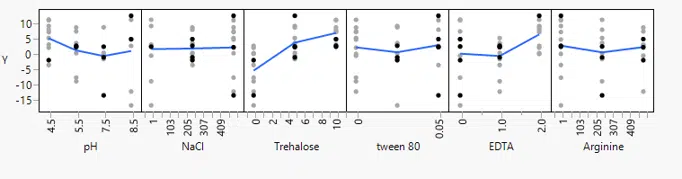
Visualize how the measured response changes as pH or excipient concentration increases.
Ranked Effects Report
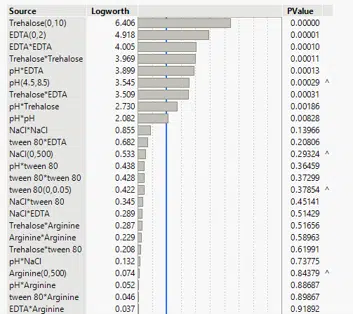
Identify the factors and interactions with the strongest positive or negative influence.
Response-Surface Models
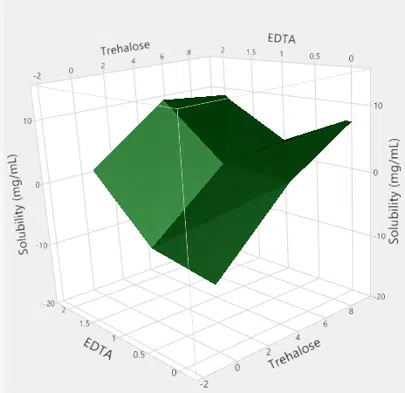
Explore combinations of formulation variables and locate promising regions for follow-up testing.