 Skip to content
Human T Cell Differentiation & Exhaustion (27-Color) Panel
A 27-color panel focused on comprehensive functional characterization of various T cell subsets from human peripheral blood.

Human T Cell Differentiation and Exhaustion 27 color
Cell populations, gating definitions, and activation/exhaustion markers.
| Population / Marker | Definition |
|---|---|
| Core gating | |
| Live Leukocytes | ZombieNIR-CD45+ |
| Non-T cell Leukocytes | CD45+ CD3-CD14±CD19± |
| Unconventional T cells | |
| Mucosal Associated Invariant T cells (MAIT) | CD3+TCRγδ-Vα7.2+ |
| γδ T cells | CD3+TCRγδ+Vα7.2- |
| Gamma Delta T cells (naïve, memory, effector) | CD45+CD3+TCRγδ+CCR7 vs CD45RA |
| Cytotoxic T Lymphocytes (CD8) | |
| Cytotoxic T Lymphocytes (CTL, CD8 Tcells) | CD45+CD3+TCRγδ- Vα7.2-CD4-CD8+ |
| Naïve Cytotoxic T cells (CTL, CD8 Tn) | CD45+CD3+TCRγδ- Vα7.2-CD4-CD8+CCR7+CD45RA+ CD28+CD27+ |
| Central Memory Cytotoxic T cells (CTL, CD8 Tcm) | CD45+CD3+TCRγδ-Vα7.2-CD4-CD8+CCR7+CD45RA-CD28+CD27+ |
| Effector CTL (CD8 Tc) | CD45+CD3+TCRγδ-Vα7.2-CD4-CD8+CCR7-CD45RA- |
| CD8 effector subsets | |
| Early Effector CTL | CD45+CD3+TCRγδ-Vα7.2-CD4-CD8+CCR7-CD45RA- CD28+CD27+ |
| Intermediate Effector CTL | CD45+CD3+TCRγδ-Vα7.2-CD4-CD8+CCR7-CD45RA- CD28-CD27+ |
| Terminal Effector CTL | CD45+CD3+TCRγδ-Vα7.2-CD4-CD8+CCR7-CD45RA- CD28-CD27- |
| Effector TEMRA | CD45+CD3+TCRγδ-Vα7.2-CD4-CD8+CCR7-CD45RA+ |
| RA+ Terminal Effector CTL (TEMRA) | CD45+CD3+TCRγδ-Vα7.2-CD4-CD8+CCR7-CD45RA+ CD28-CD27- |
| Helper T Cells (CD4, non-Tregs) | |
| Helper T Cells (Aka CD4 Tcells, non-Tregs) | CD45+CD3+TCRγδ- Vα7.2-CD4+CD8-CD127-CD25- |
| Follicular T Cells (Tfh) | CD45+CD3+TCRγδ- Vα7.2-CD4+CD8-CD127-CD25-CXCR5+ |
| CD4 differentiation | |
| Naïve CD4+ Helper T cells (CD4Tn) | CD45+CD3+TCRγδ- Vα7.2-CD4+CD8-CCR7+CD45RA+ CD28+CD27+ |
| Central Memory CD4+ T cells (CD4Tcm) | CD45+CD3+TCRγδ- Vα7.2-CD4+CD8-CCR7+CD45RA- CD28+CD27+ |
| Effector CD4+ Helper T cells (CD4Teff) | CD45+CD3+TCRγδ- Vα7.2-CD4+CD8-CCR7-CD45RA- |
| CD4 effector subsets (RA-) | |
| Early-like Effector CD4+ T cells | CD45+CD3+TCRγδ- Vα7.2-CD4+CD8-CCR7-CD45RA- CD28+CD27- |
| Early Effector CD4+ T cells | CD45+CD3+TCRγδ- Vα7.2-CD4+CD8-CCR7-CD45RA- CD28+CD27+ |
| Intermediate Effector CD4+ T cells | CD45+CD3+TCRγδ- Vα7.2-CD4+CD8-CCR7-CD45RA- CD28-CD27+ |
| Late Effector CD4+ T cells | CD45+CD3+TCRγδ- Vα7.2-CD4+CD8-CCR7-CD45RA- CD28-CD27- |
| CD4 effector subsets (RA+) | |
| RA+ Effector CD4+ T cells (CD4TEMRA) | CD45+CD3+TCRγδ- Vα7.2-CD4+CD8-CCR7-CD45RA+ |
| RA+ Early-like Effector CD4+ T cells | CD45+CD3+TCRγδ- Vα7.2-CD4+CD8-CCR7-CD45RA+ CD28+CD27- |
| RA+ Early Effector CD4+ T cells | CD45+CD3+TCRγδ- Vα7.2-CD4+CD8-CCR7-CD45RA+ CD28+CD27+ |
| RA+ Intermediate Effector CD4+ T cells | CD45+CD3+TCRγδ- Vα7.2-CD4+CD8-CCR7-CD45RA+ CD28-CD27+ |
| RA+ Late Effector CD4+ T cells | CD45+CD3+TCRγδ- Vα7.2-CD4+CD8-CCR7-CD45RA+ CD28-CD27- |
| Regulatory T cells | |
| Regulatory T cells (aka Tregs) | CD45+CD3+TCRγδ- Vα7.2-CD4+CD8-CD127-CD25+ |
| Naïve Tregs | CD45+CD3+TCRγδ- Vα7.2-CD4+CD8-CD127-CD25+ CCR7+CD45RA+ CD95- |
| Memory Tregs | CD45+CD3+TCRγδ- Vα7.2-CD4+CD8-CD127-CD25+ CCR7±CD45RA-CD95+ |
| Expression of activation/exhaustion markers | |
| CD57 | Senescense (CD8+) Cytotoxic |
| KLRG1 | Senescense (inversely correlated to PD-1) |
| PD-1 (CD279) | Exhaustion, checkpoint |
| LAG-3 (CD223) | Exhaustion |
| TIM-3 (CD366) | Exhaustion / Tolerance |
| TIGIT | Exhaustion |
| CTLA-4 (CD152) | Exhaustion, checkpoint |
| CD39 | Exhaustion / Dampens immune responses (w/ CD73, checkpoint) |
| CD73 | Survival / Tolerance / Dampens immune response (w/ CD39, checkpoint) |
| CD95 (FAS) | Activation |
| HLA-DR | Activation Level |
| 2B4 (CD244) | Checkpoint regulation, exhaustion Mem CD8+ |
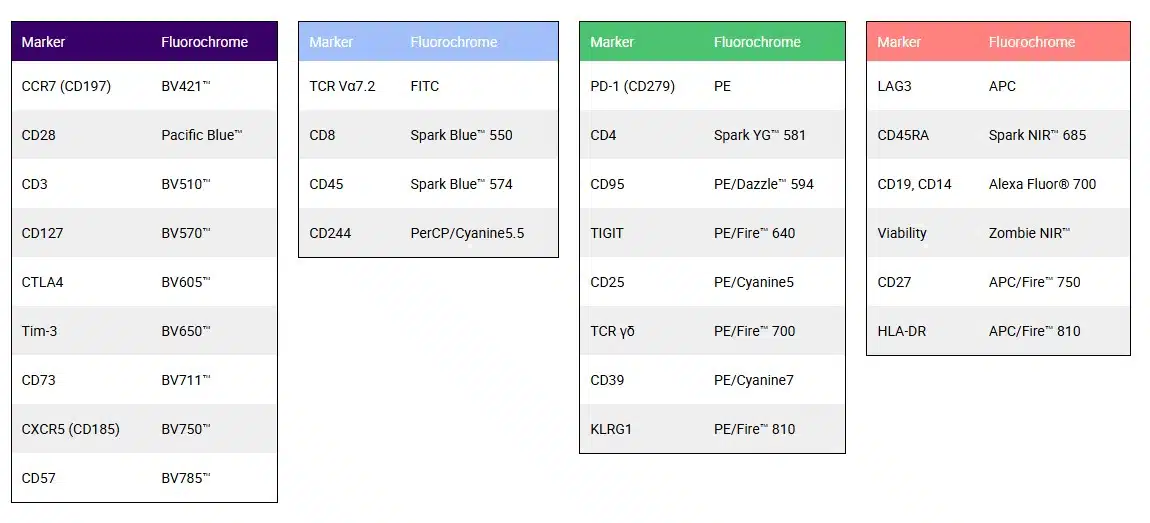
The Human T Cell Differentiation & Exhaustion (27-Color) Panel is a high pre-optimized flow cytometry panel designed to deeply characterize human T cell biology across differentiation, activation, and exhaustion states. This panel enables simultaneous identification of naïve, memory, effector, and stem-like T cell populations, while also resolving key activation markers and inhibitory receptors associated with exhaustion. With this comprehensive approach, researchers can analyze T cell function and plasticity in a single staining tube, reducing optimization time and supporting robust, reproducible immunophenotyping.
Key Features & Benefits
Trusted
27-color, pre-optimized design minimizes trial-and-error panel building.
Comprehensive T-Cell Coverage
Including naïve, central memory, effector memory, TEMRA, and stem-like subsets.
Exhaustion Markers
PD-1, TIGIT, TIM-3, and others resolve dysfunctional or chronically stimulated T cell states.
Superior Design
Designed for high-dimensional assessment of T cell health, differentiation, and functional transitions.
Workflow
Streamlined workflow enables fast, consistent T cell profiling across studies.
Target Immune Cell Populations
This panel resolves key T cell subsets central to understanding human immunity, including naïve T cells, central memory and effector memory T cells, terminal effector cells (TEMRA), and stem-like progenitor T cells. It further distinguishes early and late activation states and identifies exhausted T cell populations through inhibitory receptor expression. Both CD4+ and CD8+ T cell lineages are captured, along with TCRγδ T cells when applicable.
Scatter, Viability, and Intro T Cell Gating

Human PBMCs from a healthy donor stained with the Human T Cell Differentiation and Exhaustion (27c) panel. Samples were acquired on a 5-laser (UV/V/B/YG/R) Cytek® Aurora using manufacturer recommended standard instrument settings.
Recommended Application
The Human T Cell Differentiation & Exhaustion (27-Color) Panel is designed for studies that require high-resolution characterization of T cell function and immune status by measuring differentiation, activation, and exhaustion markers in a single assay.
This panel is particularly well suited for immuno-oncology research, where it can be used to evaluate T cell responses to checkpoint inhibitors, CAR-T therapies, and other immune-modulating treatments. The ability to identify exhausted, activated, and memory T cell subsets supports biomarker discovery, patient stratification, and longitudinal monitoring of therapeutic response.
The panel is extremely valuable for studies of inflammatory and autoimmune diseases, where dysregulated T cell activation and exhaustion contribute to disease progression. By resolving multiple differentiation and inhibitory states, the panel helps identify immune imbalances and evaluate responses to targeted immunotherapies.
This panel also supports aging and immunosenescence research, allowing investigators to examine shifts in naïve, memory, and exhausted T cell populations over time. Its comprehensive design makes it well suited for longitudinal cohort studies and translational research programs that high-dimensional immune profiling.