 Skip to content
Bacterial Expression System
\Ichor Life Sciences offers a bacterial protein expression platform to produce proteins from various biological hosts with high yields, purity and biological activity.

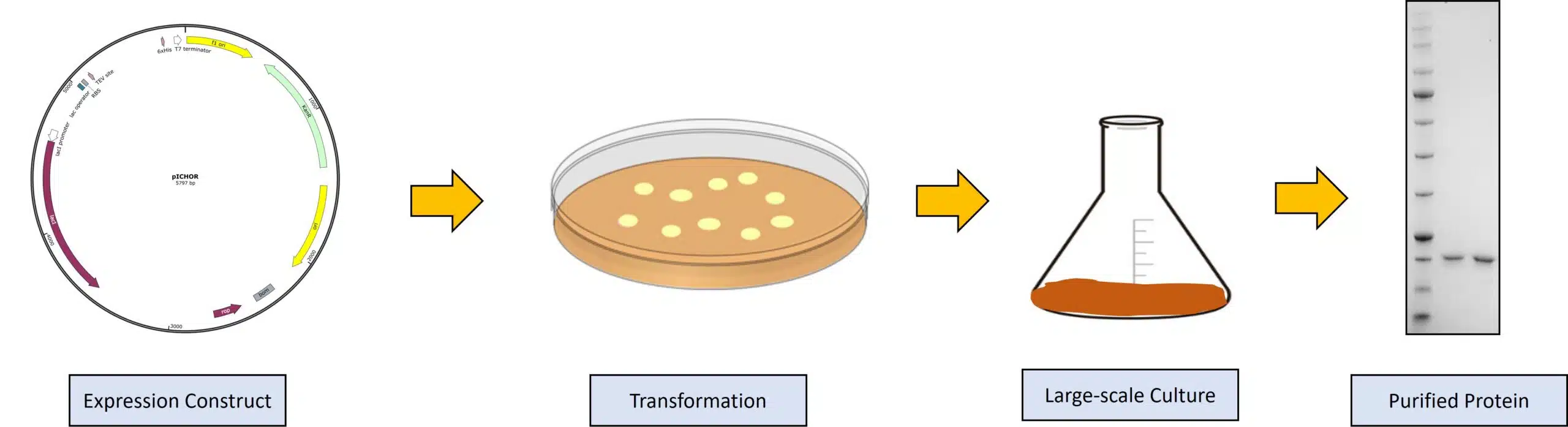
Exogenous proteins can be produced using Ichor’s bacterial protein expression service in several strains. Proteins can be purified using a variety of solubility and purification tags. We can also carry out customized expression and purification of proteins in the absence of any exogenous tags.
Construct Design
Optimal domains for protein expression are identified using available structural information. Codon-optimized DNA sequences of protein domains are designed, synthesized and cloned into expression vectors with various promoters and inducer systems.
Expression Testing
Expression constructs are transformed into various bacterial strains. Small-scale cultures are grown and protein expression is induced under multiple conditions (Varying concentrations of inducer and post-induction temperatures). Levels of protein expression are analyzed by Coomassie-blue stained SDS-PAGE to identify optimal expression conditions.
Purification Optimization
Our bacterial expression services platform can carry out purification utilizing a variety of chromatographic techniques and purification buffers. This provides a means to design optimal purification strategies to obtain pure, biologically active proteins.
Solubility and Purification Tag Scouting
Ichor can clone designed DNA sequences appended with various solubility and purification tags. This aids increasing the expression levels of protein that are expressed at low levels.
Purification from Inclusion Bodies
Our bacterial protein expression services team has plenty of experience in purifying active protein from inclusion bodies. Refolding is carried out under a variety of conditions to identify a cascade that can provide pure and active protein.
Featured Capabilities
Expression and Purification of KRAS-G12C

Human KRAS is one of the most frequently mutated oncogene. Mutation of glycine residue at position 12 is observed in a variety of human cancers. Several studies in the literature have provided evidence that this glycine residue is mutated to a cysteine (KRAS-G12C) in 40-45% of all KRAS mutations in non-small cell lung cancers (NSCLC). Hence, several inhibitors have been designed to target the KRAS-G12C protein in an effort to kill cancer cells specifically.
Featured Case Studies / Capabilities
Biophysical Assays

We are capable of carrying out various biophysical assays for target validation as well as high throughput screening. The techniques include surface plasmon resonance (SPR), Isothermal titration calorimetry (ITC), Bio-layer interferometry (BLI) as well as custom plate-based assays utilizing absorbance, fluorescence and luminescence.
X-ray Crystallography

Our highly skilled structural biology team generate high-resolution structures of individual proteins, complexes of proteins with other proteins and putative drug targets to help guide hit finding, fragment screening, and lead optimization.
Cell-Based Assays

Ichor’s cell-based assay packages deliver actionable insights by multiplexing key readouts in a single phase. Define working concentration ranges, uncover early mechanistic effects, and confirm activity in target-relevant cell populations before advancing to in vivo studies.
Frequently Asked Questions
Reach out to our team about any questions you might have about bacterial protien expression or protein expression in general.